Online 5 Love Languages Test for Couples & Kids
What the Five Love Languages Actually Mean
Across countless relationships, a simple truth emerges: people tend to give affection in the way they most like to receive it. Dr. Gary Chapman synthesized this observation into a practical framework that categorizes core preferences into five distinct channels. The model doesn’t replace empathy or commitment; instead, it gives those virtues a common language. Couples, friends, and families use it to translate good intentions into behavior that actually lands. By naming how love is best received, the framework helps partners turn abstract care into daily, tangible gestures.
At its heart, the approach is a map of needs, not a personality cage, and it welcomes change as seasons shift. Today, many readers and therapists casually reference the concept as 5 love languages Gary Chapman in workshops, books, and everyday conversations. When curiosity turns into action, some people start with the 5 love languages Gary Chapman test to anchor their reflections before deeper dialogue. The goal isn’t to score “perfectly,” but to spot patterns, experiment, and co-create a shared rhythm that honors both people’s preferences. In this way, the framework becomes less of a label and more of a living conversation that evolves with your relationship.
Why the Five Love Languages Boost Relationship Health
Understanding a partner’s preferred channel doesn’t magically solve conflict, yet it radically reduces misfires. When you customize affection to the way your partner actually receives it, you bypass defensiveness and build a climate of safety. Over time, that safety compounds into trust, which makes it easier to repair ruptures and to celebrate wins. For structured introspection during a relationship reset, couples sometimes complete the Gary Chapman 5 love languages test as a shared baseline before making commitments. If you’re tracking progress across months, the 5 love languages test Gary Chapman works as a repeatable snapshot alongside journaling and check-ins.
- Clarity replaces mind reading: you stop guessing and start asking, which reduces invisible resentment.
- Effort becomes efficient: the same energy produces more connection because it lands in the right “channel.”
- Conflict de-escalates faster: tailored repair attempts feel sincere, which softens standoffs.
- Intimacy grows: partners feel seen in concrete ways, and appreciation becomes a habit rather than a holiday.
- Resilience increases: when stress hits, you have a shared playbook for comfort and reconnection.
These benefits show up beyond romance, teams, friendships, and families all gain from clearer expressions of appreciation. The framework also complements therapy, coaching, and spiritual practices because it translates ideals into consistent micro-behaviors. Over time, those micro-behaviors shape culture inside your home and make warmth feel normal, not exceptional.
The Five Languages Explained, With Core Needs and Examples
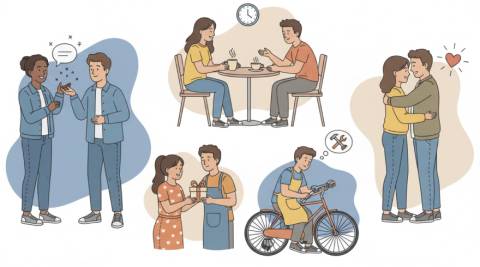
Each language speaks to a distinct psychological drive, yet all five interplay and can rotate in priority over a lifetime. Words of Affirmation soothe through praise and reassurance, Quality Time nourishes through undivided presence, Receiving Gifts symbolizes thoughtfulness, Acts of Service communicate practical support, and Physical Touch grounds connection through closeness. As you learn the nuances, a playful step is the 5 love languages Gary Chapman quiz that helps you notice patterns without pressure. For a lighter companion, the 5 languages love quiz Gary Chapman can spark conversations you might otherwise avoid.
| Love Language | What It Craves | Everyday Example | Watch-outs |
| Words of Affirmation | Encouragement, gratitude, and specific praise that validates effort | A short note highlighting something your partner did well this week | Generic compliments can feel hollow if they lack detail or sincerity |
| Quality Time | Undistracted presence and shared experiences that invite depth | Phones down for a 20-minute walk focused on catching up | Split attention undermines closeness more than silence ever could |
| Receiving Gifts | Visible tokens that symbolize thought and remembrance | A favorite snack picked up “just because” on the way home | Pricey items aren’t the point; the meaning behind them is |
| Acts of Service | Concrete help that lightens a load without being asked | Folding laundry or prepping lunch before a big day | Unwanted “help” can feel controlling if consent is ignored |
| Physical Touch | Comfort through proximity, warmth, and affectionate contact | A lingering hug at the door or a hand squeeze during stress | Consent and timing matter; some moments call for space |
Use the table as a quick reference, then translate insights into small, repeatable actions. Remember that context, culture, and consent frame every gesture, and the most meaningful expression is the one your partner requested. If two channels seem tied, alternate your efforts for a few weeks to see what reliably nurtures both of you.
How to Identify Your Primary Language (and Your Partner’s)
Self-knowledge grows through observation and experiment, not just hunches. When journaling alone stalls, the 5 love languages quiz Gary Chapman offers structured prompts that expose hidden tendencies. You can then compare impressions using the Gary Chapman 5 love language quiz to calibrate your conversation without blame. After gathering clues, discuss tradeoffs: What matters most on busy weeks versus restful weekends, and what helps during conflict versus celebration.
- Notice what you request most often and what disappoints you most acutely.
- Track “peak moments” that left you glowing, and decode which gestures caused them.
- Ask your partner to share one concrete behavior that boosts connection this week.
- Run small experiments for seven days per language, then debrief impact together.
- Revisit quarterly; new jobs, health shifts, or parenthood can reshuffle priorities.
Keep the tone collaborative and curious. The goal is to build a shared repertoire that fits real life, not to win points or prove a theory. Over time, you will assemble a personalized menu of gestures that consistently move the needle on closeness.
Practice Toolkit: Everyday Moves for Each Language
Micro-moments compound into trust, especially when they’re predictable. As a fun date-night warmup, the Gary Chapman 5 love languages quiz sets the tone for curiosity and empathy. Then, translate insights into tiny, consistent behaviors that survive hectic schedules and low-energy evenings. Think cues on your calendar, shared wish lists, and weekly debriefs that prevent drift.
- Affirmation: Offer one specific appreciation tied to effort or character every morning.
- Quality Time: Schedule a 25-minute “no-screens” ritual after dinner three nights a week.
- Gifts: Maintain a note on your phone with favorites and surprises to grab on errands.
- Service: Proactively tackle a disliked task before your partner has to ask.
- Touch: Create a greeting and goodbye routine that includes a hug or cuddle.
For couples on a budget or just starting, the 5 love languages quiz free Gary Chapman feels accessible while still encouraging thoughtful discussion. Pair your results with a simple action plan that lists two behaviors per language, and rotate them across the month. By mixing novelty with reliability, you keep affection fresh without making it fragile. The key is not grandeur, but rhythm: small, steady gestures build a resilient bond.
Common Mistakes and Myths to Avoid
Mistakes tend to happen when people treat the languages as labels rather than lenses. If your profile shifts with life stages, the 5 love language test Gary Chapman reflects new data rather than a fixed identity. Another trap is assuming your favorite channel must be your partner’s, which unintentionally centers your comfort. Finally, perfectionism can stall progress; your efforts don’t need to be cinematic to be meaningful.
- Myth: One primary language never changes. Reality: seasons, stress, and healing all influence preferences.
- Myth: Gifts equal materialism. Reality: symbolism and thoughtfulness carry the meaning, not price.
- Myth: Touch is always about sexuality. Reality: comfort and co-regulation are often the core need.
- Mistake: Delivering “service” without consent. Fix: ask first, then support how your partner prefers.
- Mistake: Chasing novelty over consistency. Fix: prioritize reliable rituals that you both can sustain.
Approach the framework as a living conversation, and you’ll sidestep rigidity. The real success metric is whether your partner feels cared for more reliably today than yesterday. With that compass, you can evolve together rather than argue about labels.
Faq: Clear Answers to Popular Questions
What are the five love languages in simple terms?
They are five common ways people feel most cared for: words of affirmation, quality time, receiving gifts, acts of service, and physical touch. Think of them as preferred channels for emotional nutrition. You can appreciate all five, but two often feel most nourishing in day-to-day life. The framework gives you shared vocabulary so you can ask for what you need, offer what lands, and repair disconnects more effectively without guesswork.
Can your primary love language change over time?
Yes, priorities can shift with context, stress, health, or milestones like moving, career changes, or parenting. During transitions, track what comforts you most and update your routines accordingly. If you want extra structure, many readers consult Gary Chapman's 5 love languages test for periodic check-ins rather than treating earlier results as permanent truth. The most important data is how you and your partner feel this month, not last year.
How do we apply this if our schedules are packed?
Start small and systemize. Choose one ten-minute ritual that fits your evenings and protect it like an appointment. Batch ideas in a shared note and set reminders so affection doesn’t depend on memory or mood. When time is tight, consistency beats grand gestures, and a reliable micro-ritual can stabilize the week more than a rare, elaborate plan.
What if we have different top languages?
That’s common and workable. Rotate gestures so each person feels tended to across the week, and make explicit requests to avoid mind-reading. During conflict, prioritize the channel that best reduces defensiveness for the hurt partner. Over time, you’ll both gain fluency in each other’s preferences, which builds flexibility and deepens mutual trust.
Are there pitfalls to taking quizzes and tests?
Quizzes are starting points, not verdicts. Treat results as hypotheses to test through real-life experiments, and revisit them periodically. Pair any insights with clear, behavioral commitments, and debrief what truly helped. When in doubt, ask your partner directly which small action would feel meaningful today, because collaboration will always outperform assumptions.