Online 5 Love Languages Test for Couples & Kids
What the Framework Means and Why a Quiz Works
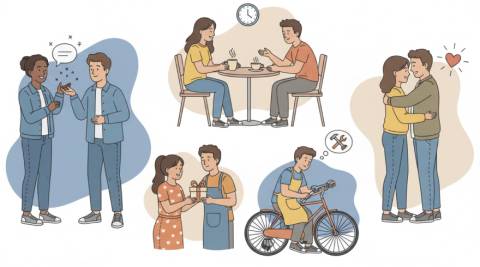
At its core, the Five Love Languages framework explains the recurring ways people express care and interpret closeness: Words of Affirmation, Quality Time, Acts of Service, Receiving Gifts, and Physical Touch. Rather than boxing you into a single style, it reveals a hierarchy of preferences that can shift with context, stress, and life stage. By naming these tendencies, you gain a shared vocabulary that lowers defensiveness, clarifies expectations, and turns vague frustration into actionable requests. The result is a relationship toolkit that helps you ask for what you need without blame, and helps you give in ways that land as intended.
Beyond pop-psych headlines, this method works because it blends introspection with behavior you can see and practice daily. Many readers discover their primary pattern through the 5 love languages quiz during a quiet evening or therapy session. If you prefer a shorter path, an accessible alternative is the 5 love language quiz that spotlights your dominant style quickly. As you reflect on recent conflicts and bright spots, you will notice how each language either soothes or sparks tension. That awareness makes it easier to replace guesswork with targeted, compassionate action, turning small moments into reliable connection points that accumulate over time.
How to Take the Assessment As a Pair and Talk About Results
When you take an assessment together, treat it like a curiosity date, not a courtroom. Set aside devices, create a calm setting, and agree that your goal is discovery. Each person should rank preferences privately first, then compare. Notice not only your top language but the gaps, what sits in third or fourth place often explains “near misses” and recurring misunderstandings. Keep the conversation playful and specific by translating insights into small experiments for the next two weeks, followed by a check-in to review what worked.
- Swap examples: “When you did X last week, I felt seen because…”
- Design tiny habits: one five-minute act per day tied to a routine you already have.
- Agree on repair cues: phrases that invite a reset before arguments escalate.
- Track wins: call out moments where a bid for connection landed well.
For partners, a useful starting point is the 5 love languages quiz couples because it frames examples in romantic scenarios you will recognize. If you want a broader view with simple prompts, you might appreciate the 5 languages love quiz as a bridge to deeper conversation. Once you both have scores, co-create a menu of gestures you enjoy, add them to your calendars, and rotate through them so appreciation never stagnates. Keep it light, iterate weekly, and celebrate progress rather than perfection.
Using the Model at Work Without Getting Awkward
Professional relationships benefit from the same clarity about appreciation, though the expressions must respect boundaries and culture. In teams, the language equivalents look like public praise, meaningful 1:1 time, helpful support, thoughtful tokens, and appropriate encouragement. The key is consent and context: ask people how they like to receive recognition and document it in a shared team charter. When leaders tailor feedback and celebrations to individual preferences, morale rises, turnover drops, and collaboration feels safer and faster.
- Calibrate norms: Decide how the team uses chat, meetings, and written notes to share praise.
- Avoid assumptions: What motivates one person can embarrass another.
- Diversify recognition: Rotate formats so everyone sees themselves valued.
- Measure impact: Pair appreciation with outcomes like shipped features or resolved incidents.
Managers often introduce appreciation preferences through the 5 love languages workplace quiz to spark a respectful discussion about boundaries and motivation. For a practical pulse-check during onboarding or retrospectives, some teams adapt the 5 love languages work quiz into a short form that feeds directly into recognition rituals. Keep gestures inclusive, non-romantic, and culturally sensitive, and you will still harvest the motivational upside without crossing lines.
Origins, Research-Informed Tips, and a Quick Comparison Table
The framework rose to prominence through clinical observations and lay-friendly writing, and it has endured because people can test it in real life within days. While it is not a replacement for therapy, it offers a low-friction lens for understanding bids for connection. A helpful complement is to track stress levels and attachment patterns, as your preferred language can shift when you are overwhelmed or when a relationship transitions from novelty to routine. Treat your results as a living document that evolves as your seasons change.
Readers familiar with popular relationship literature may appreciate that some editions present the 5 love languages by Gary Chapman quiz alongside stories that illustrate each language in everyday life. Others explore adjacent authors, and a few compare insights with the Gary Smalley 5 love languages quiz traditions to tease out nuances in how affirmation and service show up across families. To make comparison easier, scan the table for examples tailored to home and work.
| Love Language | Romantic Example | Family/Friends Example | Work-Appropriate Example |
| Words of Affirmation | Handwritten note praising effort after a tough week | Voice message appreciating a specific kindness | Public kudos in a team channel highlighting impact |
| Quality Time | No-phone walk to decompress and reconnect | Weekly coffee catch-up focused on their world | Protected 1:1 time with clear agenda and no interruptions |
| Acts of Service | Running an errand that lightens a partner’s load | Helping with a chore they dread without prompting | Jumping in to remove blockers before a deadline |
| Receiving Gifts | Thoughtful token tied to an inside joke | Care package that anticipates a need | Small milestone memento that marks progress |
| Physical Touch | Comforting hug after a long day | Warm greeting that respects boundaries | Appropriate fist-bump or none, based on preference |
Use the table as a jumping-off point rather than a script. Ask the people in your life which version lands, adapt to their feedback, and update examples as your relationships mature. Combining this clarity with gentle iteration is how you convert insight into durable connection.
Smart Ways to Try It Today
Start by setting an intention: Are you aiming to ease conflict, revive routine, or strengthen a thriving bond? Next, choose a time window of two weeks to try three micro-habits aligned with your top languages, and write them down where you will see them daily. Recruit a friend or partner as an accountability buddy and agree to exchange notes on what felt meaningful versus what fell flat. Keep gestures small on purpose; tiny changes stack gracefully and reveal patterns faster than grand gestures that are hard to repeat.
- Pair a new habit with an existing cue, like brewing coffee or finishing a workout.
- Use specific language when appreciating someone to reduce ambiguity.
- Rotate gestures across languages to keep experiments fresh.
- Schedule a short weekly review to tune your approach.
If cost is a concern, you will still gain deep insight by choosing a reliable option such as the 5 love languages quiz free available from reputable sources. Many people prefer to begin with a streamlined path like a free 5 love languages quiz before investing more time in guided workbooks or coaching. As your confidence grows, consider pairing your results with journaling prompts, calendar nudges, and check-ins that make your practice consistent and visible. Consistency, not complexity, is the secret to sustainable connection.
Faq: Independent, Practical Answers
How accurate are these assessments?
Accuracy depends on honest self-reflection and context, because your preferences can change with stress, routine, or life transitions. Treat your results as a snapshot rather than a permanent label, and revisit them after big shifts like a new job, a move, or becoming a parent. Discuss edge cases with your partner or team so you can refine how you give and receive appreciation in different settings.
How often should I retake an assessment?
Most people benefit from revisiting results every six to twelve months, or after major changes in schedule and responsibilities. You can also retest after a focused experiment period to see whether your day-to-day behaviors reshaped your perceived priorities. For a quick recalibration, some choose a short form like a 5 love languages quiz test to confirm whether their top two preferences remain stable.
Can I have two primary languages?
Yes, many people show a tight cluster at the top, and that is perfectly normal. Think of it as a blend where the ratio shifts depending on mood, energy, and recent experiences. Use that knowledge to vary your gestures so your relationships feel rich rather than repetitive, and keep communicating about what lands best this season.
Is this useful beyond romantic relationships?
Absolutely, the same clarity helps families, friends, and colleagues offer appreciation in ways that actually resonate. Translate romantic examples into context-appropriate gestures, set boundaries, and check cultural norms. In community and team settings, a concise resource such as the 5 love languages love language quiz can surface preferences without making things awkward.
What if my partner and I have opposite preferences?
Opposite preferences are common, and they are workable with a little planning. Trade small, frequent gestures targeted to each other’s top language, and create routines so the effort feels natural. When conflicts arise, use your shared vocabulary to repair quickly and return to connection.